snaQme Co., Ltd.
- BIMI
snaq.me Adopts BIMI and VMC:
Using Its Logo to Raise the Value of Every Email It Sends at Scale [Case Study]
snaQme Co., Ltd.
snaq.me, the company behind the snack subscription service of the same name, has introduced logo-enabled email (BIMI) and the Verified Mark Certificate (VMC) to raise the value of every one of the many emails it sends to customers.
The company moved quickly, aligning the project with a review of its email delivery infrastructure.
Since its founding, the company has operated its snack subscription service, also called “snaq.me,” which delivers snacks to customers on a regular basis. In addition to the subscription, it runs an e-commerce store where customers can make one-off purchases, and in recent years it has also been expanding its services for offices. In this interview, we spoke with Mr. Miyoshi, co-founder and CTO (Chief Technology Officer), who led this project—from building the company’s email systems to configuring DMARC and proposing the initiative internally.
Hayato Miyoshi, Co-founder and CTO (Chief Technology Officer), snaq.me
Interview date: October 26, 2026
GMO Brand Security, Inc. supported snaq.me in obtaining its Verified Mark Certificate (VMC).
Key Points
- • Industry: A startup offering a snack subscription service and e-commerce (D2C)
- • Timing: Obtained a VMC in April 2026 and began displaying its logo with BIMI
- • Delivery environment: Moving from Amazon Pinpoint (with Amazon SES handling the actual sending) to the company’s own delivery system on AWS
- • Goal: Branding (raising the value of each of the many emails the company sends)
- • DMARC: Configured by the CTO himself; policy set to quarantine
- • Where the logo appears: Supporting email services such as Gmail (Outlook is not currently supported)
- • Internal process: Collected case studies and obtained approval at a management meeting; securing the budget was not difficult
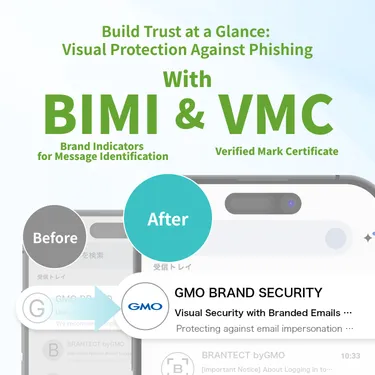
- *BIMI (Brand Indicators for Message Identification): A standard that displays a company’s logo on emails that pass sender domain authentication.
- *VMC (Verified Mark Certificate): A digital certificate in which a third-party certificate authority verifies that a logo is a registered trademark owned by the company, so that the logo can be displayed with BIMI.
- *DMARC (Domain-based Message Authentication, Reporting and Conformance): A standard that lets senders specify how receivers should handle spoofed email (none / quarantine / reject), based on the results of sender domain authentication (SPF and DKIM). BIMI requires a policy of quarantine or stricter.
Reviewing the Email Delivery Infrastructure as Amazon Pinpoint Reaches End of Support
——What kind of email delivery environment does your company use?
Until now, we delivered our emails through Amazon Pinpoint, AWS’s customer messaging service, with Amazon SES handling the actual sending. We have developed our own customer relationship management (CRM) system, and we also use Zendesk for some individual replies to customer inquiries.
Amazon Pinpoint was scheduled to reach end of support on October 30, 2026, so it was time for us to rethink how we deliver email on AWS. It was during this review that I learned about BIMI, and since the timing seemed right, we went ahead with the implementation. We are now switching to our own delivery system on AWS.
*Amazon Pinpoint: A customer messaging service formerly offered by AWS (Amazon Web Services); support ended on October 30, 2026. It determined “who receives what, and when,” and offered audience segmentation, campaign delivery such as newsletters, automated journeys triggered by user behavior, and analytics such as open rates.
*Amazon SES (Simple Email Service): AWS’s email sending service. It delivers emails created in Pinpoint and other tools to the recipients’ mail servers. The DKIM signing and SPF settings required for DMARC authentication are also configured on the SES side.
Every Email—from Newsletters to Order Confirmations—Is BIMI-Ready
——What types of emails do you mainly send?
We send newsletters, such as announcements of new products and general campaigns.
Customers can also take various actions on our service, such as rating products or making requests, and many of our emails are triggered by those actions—follow-up emails and emails for various initiatives designed to increase engagement.
All of our emails, including e-commerce order confirmations and shipping notifications, are sent from the same domain (@snaq.me), so our logo appears on every email in supporting email services. Our recipients include not only current subscribers but also people who have opted in to receive our emails but have not yet made a purchase.
DMARC Configured by the CTO Himself and Raised to Quarantine
——What prompted you to start working on DMARC?
It started when I noticed, while looking through the emails I received, that some companies displayed a logo and others did not. As I researched what made the difference, I came across both BIMI and DMARC.
As for anti-spoofing measures, we had only a very light configuration at first, so I decided we needed to do this properly as well.
——Were there any hurdles or concerns as you moved forward with the configuration?
I didn’t find it especially difficult or troublesome. We have built our email systems in-house, and because I have been involved with them all along, I had a good grasp of what the changes would affect. I think that made a big difference.
I also led the effort to raise our DMARC policy myself, rather than handing it off to another department. It is now set to quarantine.
Getting in Now, While There Are Benefits to Gain: Why snaq.me Adopted BIMI
——How did you come to consider logo-enabled email (BIMI)?
When I looked into which companies displayed logos, I found that very few startups or companies in similar industries had adopted BIMI yet. But I thought it would eventually become essential, so rather than being affected by it later, I felt it would be better to be in a position to benefit from it now, and I proposed it internally.
Our primary goal is branding. We have heard almost no reports of spoofing damage so far, but we also felt that if we were in a position to say we had proper measures in place should something happen in the future, that would give peace of mind both to our customers and to us.
——What email-related challenges did you face before implementing BIMI?
We send a very large volume of email, so we were concerned that the more we sent, the more our brand might be worn down. We have also taken steps such as setting an upper limit on the total number of emails we send.
Rather than simply adjusting the number of emails, we wanted to raise the value of each one and make that value visible. Of course, we also want to improve open rates, and we believe our logo can help people who have not yet made a purchase get to know our brand.
Approved at a Management Meeting, with No Trouble Securing the Budget
——Could you walk us through the schedule and steps leading up to implementation?
I collected case studies, and once I had concluded that it looked worthwhile, I brought it to a management meeting and obtained approval. Because the VMC review includes a phone verification with the applicant company, about the only other thing I did was let our CEO know to expect that call.
There was hardly any opposition within the company. I had read about the results on other companies’ blogs, and I also explained roughly how much revenue might change if our open rates increased, so securing the budget didn’t take long.
The only collaboration with other teams was asking our designer to create an SVG version of our logo. Otherwise I handled things on my own schedule, so my impression is that we didn’t run into any major obstacles.
——Were there any difficulties or creative approaches during the implementation?
If I had to name one, when we configured DMARC and raised the policy, some emails may not have been delivered properly. The issue was resolved within a few hours.
We worked from the DMARC reports, compiled and shared a list of recipients who might not have received our emails, and arranged for them to be contacted again.
Introducing the Logo in the FAQ as a Mark of Official Email
——What changes or effects have you seen since the implementation?
We haven’t made a big announcement, so we haven’t received any feedback from customers yet. On our public FAQ page, we explain that emails from “@snaq.me” display our logo and a verification checkmark, and we ask customers to use them as a sign that an email is officially from us.
We plan to look more closely at effects such as open rates going forward.
*snaq.me FAQ (in Japanese): “The snaq.me logo now appears on emails you receive” (posted April 30, 2026) https://faq.snaq.me/hc/ja/articles/57462933402265
”If You Are Considering It, It’s Better to Move Forward at That Stage”
——How would you like to use or expand BIMI going forward?
Since individual customers make up most of our sales and user base, we are focusing on them first, but I hope the benefits will also extend to our business customers.
We want to keep a close eye on authentication and security in general and continue to respond to new developments.
——Do you have any advice for companies considering BIMI?
I think we have reached a point where, if you don’t set it up early, your brand’s trust can gradually erode without you even noticing.
Right now, not many companies display a logo, so it may be hard to feel the difference. But as that number grows, emails without a logo may come to be seen as suspicious. Personally, I think that if you are considering it, it’s better to move forward at that stage.
Outlook doesn’t support BIMI at the moment, but given the global trend, I expect it will eventually.
Frequently Asked Questions (FAQ)
Q. Can BIMI be used with emails sent through Amazon SES?
A. Yes. DKIM signing and SPF must be configured on the SES side, and the emails must pass DMARC authentication. snaq.me also implemented BIMI in a delivery environment that uses Amazon SES.
Q. Does the BIMI logo appear in Outlook?
A. Not at present. The logo appears in supporting email services such as Gmail, iCloud Mail, docomo Mail, and au Mail.
Q. Is there a phone verification during the VMC review?
A. Yes. Because the applicant company receives a verification call, it helps to let the relevant people inside the company know in advance (in snaq.me’s case, the CEO).
Interview and text: GMO Brand Security, Inc.